Thursday, May 11, 2017

New 2017 Study shows Invisalign only 50% effective v. Braces


New 2017 Study shows Invisalign only 50% effective v. Braces

I have previously reviewed several articles concerning Invisalign and other clear aligner systems used to move teeth and there is a fair amount of debate at the specialty level of Orthodontics as to how much we should be using these aligners and how they are abused in so many inexperienced dental offices.  In fact, previous studies have shown Invisalign to have a dismal 41% mean accuracy of tooth movement with a range from 18% to 47.1% (j.ajodo.2007.05.018;www.ajodo.org) and mean percentage of single tooth movement goal of only 57% (j.ajodo.2013.10.022). 

 
When results from Invisalign were compared to traditional braces using American Board of Orthodontic standards, the Passing rate of cases treated with Invisalign were 27% lower (j.ajodo.2005.06.002).  Even worse, another more complete study (j.ajodo.2004.07.016) actually concluded that there was a “minimal improvement in occlusal score based on Board standards from 47 to 36.4 [0 being ideal] and there was a negative change (2.5x worse AFTER treatment) in posterior occlusion contacts with Invisalign.”  
 

This last investigator summarized Invisalign treatment by stating “According to the OGS [Objective Grading System used for the American Board of Orthodontics], Invisalign did not treat malocclusions as well as braces … Invisalign was especially deficient in its ability to correct large anteroposterior discrepancies [overjet] and occlusal contacts.”

 
Last month (April of 2017), a new article was published in the Journal of the American Association of Orthodontics that confirmed previous findings.

The finding s of the new article from April 2017 (http://dx.doi.org/10.1016/j.ajodo.2016.09.022) , are summarized below.  

Management of overbite with the Invisalign appliance


x

“Our results suggested that about 1.5 mm of overbite improvement can be expected when the Invisalign appliance is used in deepbite patients. A previous systematic review on the stability of deepbite correction reported an average of 3 mm overbite correction with fixed appliances [traditional braces].13 Our result of a 1.5-mm median correction in open-bite patients is half of the reported average open-bite correction with a nonsurgical fixed appliance approach.25 These comparisons may indicate that aligners can usually improve deepbites and open bites, but they might not accomplish as much correction as fixed appliances.”


Two things to draw from this study:

  1. Overbite was corrected on mild cases an average of 1.5mm
  2. Overbite corrected by traditional braces for mild cases averages 3mm
  3. Traditional braces correct 100% more of the overbite than Invisalign on average.
  4. Invisalign is only 50% as effective as traditional braces in correcting overbite.

So relative to braces, Invisalign is half as effective and therefore not clinically sound method to treat when we can treat 100% more with traditional braces.  And this is only one part of a malocclusion a patient may have.


Another area of malocclusion was also evaluated; mild anterior openbites.  This study only looked at patients from three Invisalign offices that had already filtered out the moderate cases for surgery (the author does not state if these discounted cases could have been treated with traditional braces or what those patients did for treatment).

Even with these more moderate to severe cases not included, this study shows that Invisalign cannot intrude or push teeth back into the bone as braces can, in fact all of the bite closure for even these mild cases was through folding the incisors back and down; no mention was made as to the effects on the gingival display (gumminess) and no long-term information was gathered to evaluate for relapse.  This is especially a weak point since these cases (and extrusion of teeth in particular) has been shown in Orthodontic literature to relapse over and over.

In fact when it came to evaluating the post-Invisalign cases, the author simply states the following:


“The second limitation of this study was that almost 50% of screened patients were not included because of the absence of posttreatment cephalometric radiographs. It is unknown whether this might have introduced selection bias to this study.”

 
In other words, if the doctors didn’t take post-Inivisalign records (for instance the results were not good and they didn’t want to have them in the study), they were simply not included in the study.  So we can safely assume this study is full of the best cases only with any failures filtered out of the averages.
 

But even with the results skewed to the most successful treatments, Invisalign is simply not close to the effectiveness of traditional braces.  They are bound by the limitations of a removable tray that has to be loose enough to be removed and over time, fatigues and becomes essentially inert.  Even Invisalign studies show that any tooth moment occurs the first 48 hours of the tray and the next few weeks really show no movement.  This is a clear sign that tray cannot produce the constant forces necessary to make full tooth movmennts.

 
So if the research is so plain and clear, who is pushing Invisalign to the public?
 

The problem now stems from profit-based corporate companies like Align Technologies (Invisalign) and other brands such as Clear Correct and Smile Club advertising directly to the public as if Orthodontics is no different than a trip to the salon and similar to whitening your teeth.
 
Doctors now invested in Invisalign (such as those in this study), also will make statements suggesting relative success in corrections without telling the public that 50% success means 50% failure when compared to braces.  I wouldn't accept a 50% in a grade from any of my four kids and I certainly wouldn't be bragging about a 50% result v. another Orthodontist's cases but that is exactly what Invisalign and Invisalign doctors are saying and many times it's because they know what the public wants and don't want to lose business even though they know there is a better treatment.
 

In fact, Orthodotics is very complex, so much so that it takes two to three years of specialy traingin After dental school to be called a Specialist or Orthodontist.  Companies will lead you to believe a computed scan with a tech can plan and align your teeth equal to traditional braces and this is simply not the case.


Consider sticking a pencil into a soft wax candle jar.  Now imagine simply pushing the pencil over with finger pressure; the pencil will move but will tip.  Now grab the pencil tight and try to move it completely sideways through the wax.  This will illustrate the difference between Invisalign (tipping) and traditional braces (true root movement).  Without the later, there is no way to correct teeth in all three dimensions and any correction from tipping will likely lead to significantly more relapse.


                            So are so many doctors now advertising Invisalign?


    1. It is all General Dentists can do without training for braces.
    2. Orthodontists are losing referrals to General Dentists who now believe they can treat their patients and keep everything “in-house” so they are trying to keep their patients.
    3. Advertising by a Billion dollar public company is telling patients that clear aligners can give them a smile (though they neglect to talk about function/health) and that braces are essentially “old technology” and not necessary.
    4. Align Technologies threatens lawsuits against criticism of their product; they are protecting their profit by any means.  They also pay doctors to use their product by offering free advertising, referring patients directly to doctors that treat more with Invisalign and they donate to all levels of the dental organizations.


So why should you care?


There is a reason that all dental offices in the state of Texas must be owned by a licensed dentist; only a dentist can be truly held accountable for dental care.  Companies have only one primary objective: profit.  IF they can get profit from a great product then by all means, good for them.  But if they rely on borderline false advertising or advertising by omission to push their product then the patient gets compromised treatment that will lead to relapse, recession or bigger functional problems years later. 
 

Patients should always ask their doctor: Is this the best treatment?  How would braces be different than aligners?  Patients should also avoid any doctor who only offers Invisalign since we know from the literature that Invisalign is only 50% as effective as braces for even minor movements correctible by traditional braces.
 

If a patient accepts to treating to a lesser standard without having to wear braces (and is aware of any risks of functional disturbances in their occlusion afterward), then there is no problem. I personally would never treat and leave a patient in a functional malocclusion out of pure liability because I plan on practicing for many years but if a patient wants this and goes somewhere and they disclose the limitations then at least it is an inform decision. 


How do I know my General Dentist treated me to a Functional Bite?


The best way to check your bite after treatment with Invisalign by a general dentist is to have a certified Orthodontist see you after treatment.  Be up front, let them know that you have treated with aligners but that you just want to make sure there are no big issues functionally.  Usually, a good Orthodontist will just keep to the big stuff; he or she is not looking to re-treat patients or openly criticize someone else’s work, but they will now be responsible for identifying any problems and informing you of potential issues.  Keep in mind, aligners are rarely going to provide ideal occlusion simply due to the plastic between the teeth and due to any jaw shift that changes the bite from before the aligners to after (all trays are made from the initial scan and may only be altered once during the entire treatment).  Regardless, large problems that can lead to recession, damage to teeth and damage to joints will have to be disclosed.  From there, you can decide what path to take but at least you will know.


If you have questions or comments concerning this or any orthodontic question, please feel free to make a complimentary new-patient appointment at either my Steiner Ranch location or my North-central Austin location on West 35th street and MoPac.


Dr. James R. Waters is a 1996 graduate from UTHSC Dental School in San Antonio, 1997 graduate of Advanced Dentistry from the UNMC in Nebraska and the 2001 Valedictorian graduate from the prestigious Saint Louis University Orthodontic Program receiving the J.P. Marshall award for clinical excellence in 2001.  He holds a Bachelor’s Degree in Science, Doctorate in Dental Surgery, a post-doctorate certificate in Advanced Dentistry, post-doctorate Degree in Orthodontics & Dentofacial Orthopedics and a Master of Science Degree in Orthodontics and is a Diplomate of the American Board of Orthodontics.  Dr. Waters and his wife of 21years live in Austin, TX with their 4 children where he has a thriving, multi-faceted Specialist practice with locations in Steiner Ranch and North-Central Austin.  You can learn more about Dr. Waters at BracesAustin.com. 
 
Steiner Ranch Office, Austin, TX

Central Austin office on 35th Street, Austin, TX


Thursday, May 4, 2017

Why are Holding Arches important?


Why is it important to keep baby teeth and hold space if they are lost?


One of the first things many parents run into at their child’s dental visit besides regular cleanings and the occasional filling, is the question of removing baby teeth v. putting more money into saving them.  They may also be told that space must be maintained following loss of a specific baby tooth.  Before getting upset and thinking your Dentist or Pedodontist is trying to pile on to your child’s treatment plan, I want to explain the sequence of how permanent teeth erupt and how the baby teeth are important in the eruption of adult teeth (and overall alignment of teeth).

 
So generally lower baby teeth erupt from front to back with lower incisors erupting first (usually around 8mo to 12mo) and baby second molars erupting at around age 2yrs.  The chart below gives an overall summary (note the wide varied eruption estimates revealing a wide range of “normal” eruption pattern.


You will notice that there are no baby premolars (bicuspids); there are only 20 baby teeth (10 upper, 10 lower) as opposed to 32 adult teeth (16 over 16).  This will play a part in development as I explain later.  But for now, the important thing is that most children will have their full complement of baby teeth from age two forward.


When the permanent teeth begin to erupt at around age 6, the first to erupt are usually the same as the primary teeth; that is the lower front baby teeth get loose (ideally) and the lower permanent incisors erupt to take their place (usually starting out behind the baby teeth only to be pushed forward into the arch by the tongue).


What parents may not realize is that the next permanent teeth to come in actually come in behind the last baby molars around age 6 to 7. The importance of this may escape most people but what this means is that all of the space for the future permanent teeth is set by the time the permanent 1st molars erupt around age 6 to 7; permanent canines and premolars won’t erupt for another 4 to 5 years.  Any loss of space from permanent molars drifting forward will increase crowding of future teeth and can reach the point of requiring removal of teeth to align.


Also, since the permanent premolars develop under baby molars (remember, no baby premolars), it turns out that the baby teeth actually hold more space (termed the “Leeway Space”) since the premolars are smaller than baby molars overhead.  In fact, maintaining this Leeway space can make save up to 3mm per side and can make the difference in a borderline extraction case of braces later of whether we remove permanent teeth or not.  Holding this space can also help to prevent severe crowding and/or impaction of teeth as they try to erupt.


To illustrate this, consider the following patient where an upper left baby 2nd molar was removed early and inadequate efforts were made to hold space (there is actually a bar attempting to hold space however these un-lateral bars are insufficient to hold space in my experience as this demonstrates).

 
Notice the space on the right in front of the banded tooth; this space of 3mm is left over from a 10mm tooth that was removed.  The bar was placed late and space continued to be lost.


In the radiograph, you can see the severe crowding under the lost space (in fact there is crowding throughout the arch due to a general narrowness and under-development of the arches).


Following expansion of the upper arch to restore the arch size and an early effort to re-open some of the lost space, you can still see the lingering effect of this lost space as the premolar erupts more into the roof of the patient’s mouth.
 
It may seem unfair that that the molars will drift forward when baby teeth are lost however this is why the baby molars are larger than the underlying premolars; because the permanent teeth drift forward, Leeway space is always lost during the natural eruption of teeth so having extra space gives time for the premolar to erupt before it gets blocked.
For this reason, anytime a baby molar (especially a baby 2nd molar) is lost before the permanent teeth are ready to erupt or even if we need to use the Leeway space, your dentist or Orthodontist will likely recommend a “Holding Arch” to maintain the Leeway space.


In the lower arch, the holding arch is a bilateral holding arch from permanent molar to permanent molar.


In the upper arch, we generally prefer a wire running across the roof of the mouth extending from molar to molar.


Believe it or not, a simple holding arch as those shown above can easily prevent the need to remove permanent teeth later and can reduce crowding significantly.  So when your Dentist, Pedodontist or Orthodontist recommends a holding arch, you can be sure they are looking out for the best interests of your family.  Likewise, if there is a chance to save a baby tooth with a Stainless Crown and baby root canal (pulpotomy) instead of removing it and having to place a holding arch, you can see it may be worth the cost, especially if that tooth in question is supposed to be there for a few more years.


If you have questions or comments concerning this or any orthodontic question, please feel free to make a complimentary new-patient appointment at either my Steiner Ranch location or my North-central Austin location on West 35th street and MoPac.


Dr. James R. Waters is a 1996 graduate from UTHSC Dental School in San Antonio, 1997 graduate of Advanced Dentistry from the UNMC in Nebraska and the 2001 Valedictorian graduate from the prestigious Saint Louis University Orthodontic Program receiving the J.P. Marshall award for clinical excellence in 2001.  He holds a Bachelor’s Degree in Science, Doctorate in Dental Surgery, a post-doctorate certificate in Advanced Dentistry, post-doctorate Degree in Orthodontics & Dentofacial Orthopedics and a Master of Science Degree in Orthodontics and is a Diplomate of the American Board of Orthodontics.  Dr. Waters and his wife of 20 years live in Austin, TX with their 4 children where he has a thriving, multi-faceted Specialist practice with locations in Steiner Ranch and North-Central Austin.  You can learn more about Dr. Waters at BracesAustin.com. 


Tuesday, May 2, 2017

Enamel Surface Roughness following polishing teeth and removal of Braces


Surface roughness following Orthodontic de-bonding, re-shaping and polishing


Although I have addressed the benefits and sometimes need to re-shape teeth as part of orthodontic treatment and following removal of braces, I wanted to present the public with more specific studies which looked at surface roughness following interproximal reduction of teeth, re-shaping of teeth and (in the 2nd study) following removal of bond cement when braces are removed.  I wanted this information out there for those few parents and patients that are nervous or concerned about the enamel following braces, specifically following any re-shaping or polishing of the enamel.


In the recent April 2017 American Journal of Orthodontics & Dentofacial Orthopedics, there was a study published (Meredith, Farella, Lowrey, Cannon and Mei; AJODO.2017.04.151) which used Atomic Force Microscopy to analyze the enamel nanotopography (surface of the enamel at a scape of 1/1,000,000,000 of a meter or a nanometer) following reshaping of enamel during Orthodontic procedures.  Without going into minutia detail, this prospective study used 64 teeth and performed various levels and types of re-shaping with diamond strips, diamond burrs (handpiece) and several polishing discs.
 

Control teeth (with no re-shaping or polishing at all) showed normal enamel roughness or ridges of 149 +/- 39 nanometers (1nm = one billionth of a meter). To give you a sense of the scale this study was measuring (and the extreme minimal effect of braces to teeth), consider that Viruses are 30 to 50nm in width, DNA is 2.5 nm in width and a single atom is .1 to .3nm in width!  So before you see the results, remember the scale we are employing  just to detect a difference in the enamel surface from pre to post-orthodontic debond and polishing.


DNA strand, 2.5nm

 
So the Results showed the initial re-shaping with diamond burs (handpiece) all produced rougher surfaces with values from ridges of 702 +/- 134nm, various strips ranged from 501 +/- 115nm down to 318 +/- 50nm with fine curved discs showing ridges of 224 +/- 65 nm.  The smoothest enamel was seen following a series of Sof-Lex discs leaving surfaces with ridges averaging 37 +/- 14 nm. 


A few things to take from this important study:

  1. Enamel has natural ridges at the nanometer level; teeth are not glassy on the surface.
  2. Your Orthodontist should be using round discs to polish teeth (Sof-Lex discs produced the smoothest surfaces, 3x smoother than normal average enamel).
  3. Enamel can be re-shaped and re-polished to its original and even better surface quality
  4. Sof-Lex discs can polish the surface of enamel to leave ridges and valleys the less than the height of a single virus or only 300 atoms high!


How does de-bonding and cleaning enamel after braces affect surface roughness?


I want to also include a summary from another similar atomic force microscopy study looking particularly at the surface of enamel following de-bonding (after braces are removed) also published in the AJODO (Mohebi, Shafie and Ameli; AJODO,2017.03.151).  In this prospective study, 30 teeth were bonded and de-bonded using composite cement and then the remnant cement was removed using different methods; a white stone bur and a tungsten carbide bur.


Results revealed no significant difference in surface roughness following removal of the remnant cement between the groups however the Tungsten bur was significantly faster/more efficient.  The surface roughness was increased when compared to the control teeth (average 87.7 nm) v. post-composite removal (average 179nm) which the study pointed out was known to be the case as investigators have repeated previously.


Ultimately, these two studies together reveal what is likely the most effective and efficient means to remove composite cement from teeth following deband:
 
  1. Remove brackets
  2. Remove residual composite cement with Tungsten Carbide bur
  3. Polish surface with Sof-Lex disc method

Sof-Lex polishing discs with slow speed handpiece.

The public should keep in mind that it takes a fairly strong bond between bracket (braces) and the teeth to be able to move the teeth and the roots.  I always compare root movement to sticking a flat knife into a tub of cold butter and trying to move the knife sideways while keeping it upright.  This is exactly why clear aligner trays such as Invisalign, Clear correct and even Orchestrate3D (the specialist version of aligner trays) are so limited in their overall movements and why studies from the AJODO have repeatedly demonstrated the poor accuracy of tooth movements with trays (anywhere from 18% to 44%).  Of course the trade off is that fixed braces must be cemented well enough to withstand not only forces of movement but also forces of mastication; it should be no surprise that we expect some (extremely) minor surface roughness immediately following debond. 


How do I Personally clean cement from braces?


Ever since I have been in practice, I have always removed excess cement 1st with a plier to scrape any large remnants, then with a Tungsten Carbide bur with a hand-piece to remove the more stubborn remnant composite (I use 3M Transbond cement for brackets/braces and Fuji II Glass Ionomer cement for bands) then I follow every case with a series of Sof-Lex discs (I use the soft color-coded system from black to dark blue to medium blue and finally with the super-fine light blue).  I think my experiences as a general dentist years ago, prior to specializing in Orthodontics, instilled in me a standard to follow.  In fact, so many times I had seen patients treated that came back to me with terrible scarring to the surfaces of the teeth and it always frustrated me to think of all of the work and time involved with Orthodontic treatment only to see the surfaces with gouges and scratches that could have easily been either prevented or polished (most of which I ended up polishing afterward for the patient).


Because of my experience and history as a general/cosmetic dentist prior to Orthodontics, it was no surprise to me to see the results from these recent studies and I am pleased the literature makes recommendations for the good of the patients that I know have worked for me and my patients for over twenty years.


If you have questions or comments concerning this or any orthodontic question, please feel free to make a complimentary new-patient appointment at either my Steiner Ranch location or my North-central Austin location on West 35th street and MoPac.


Dr. James R. Waters is a 1996 graduate from UTHSC Dental School in San Antonio, 1997 graduate of Advanced Dentistry from the UNMC in Nebraska and the 2001 Valedictorian graduate from the prestigious Saint Louis University Orthodontic Program receiving the J.P. Marshall award for clinical excellence in 2001.  He holds a Bachelor’s Degree in Science, Doctorate in Dental Surgery, a post-doctorate certificate in Advanced Dentistry, post-doctorate Degree in Orthodontics & Dentofacial Orthopedics and a Master of Science Degree in Orthodontics and is a Diplomate of the American Board of Orthodontics.  Dr. Waters and his wife of 20 years live in Austin, TX with their 4 children where he has a thriving, multi-faceted Specialist practice with locations in Steiner Ranch and North-Central Austin.  You can learn more about Dr. Waters at BracesAustin.com. 


Wednesday, April 19, 2017

Re-shaping and polishing edges of teeth after braces


Re-shaping edges of teeth as part of Orthodontic Treatment

 
Orthodontics has been correctly described as part art, part science and part mechanics.  No other field in my opinion balances these disciplines as well as the specialty of Orthodontics.  So it is probably no surprise to most that Orthodontists are somewhat perfectionists.  And although we strive to restore ideal function and provide a solid and stable occlusion for each patient, we also want to provide a beautiful smile.  Sometimes this may mean leveling the teeth, adjusting the gum level of teeth, closing spaces, correcting rotations, reducing overjets and/or overbites, etc., etc.  But one area we also can correct is the incisal edges of teeth.


Adult with severe wear from heavy long-term hyper-occlusion.  Alignment complete but incisal edges un-supported and fragile as well as unsightly.


Following re-shaping to restore strong edges to the teeth to resist future wear now that alignment has restored proper function.


Imagine teeth that have been sitting rotated or crooked for years; even a teen may have front teeth for 6 to 8 years until they are corrected. Now imagine how the edges of the upper and lower teeth abrade and wear against each other.  Over time, the edges will start to flatten based on the opposing teeth.  Then imagine that the teeth are abruptly straightened so that all roots are parallel.  In these cases what we see is that the edges of the teeth are no longer level (they were level relative to the original opposing teeth which are now straightened).  So the teeth after braces are straight but the edges can be angular/un-level/flattened or even chipped.


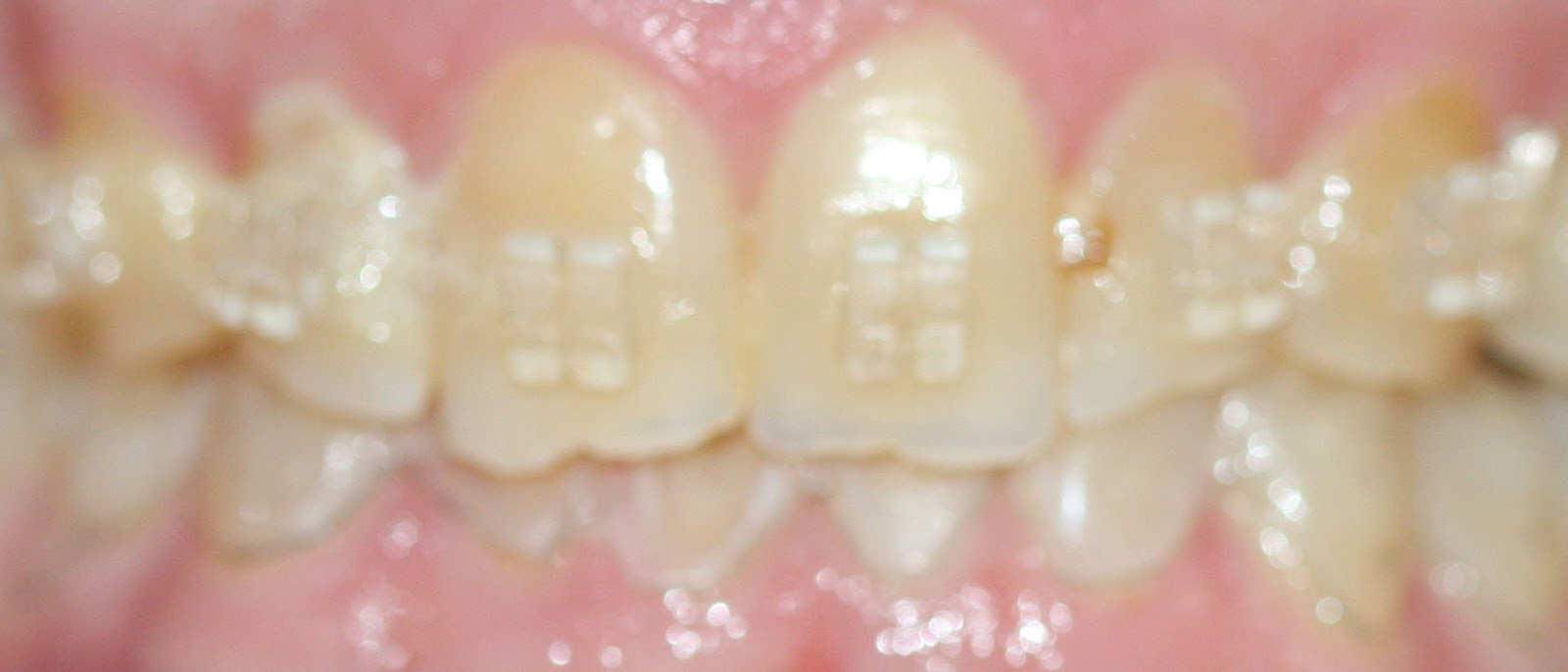
Initial photo of a young adult with a full underbite and damage to edges.

 
Once the underbite has been corrected, you can see the damage to the edges from the previous poor occlusion.


Note that we aren’t trying to shorten all the teeth to the highest point where the fractured edge reaches; we only want to restore any sharp edges with a softer and stronger rounded edge.


So why are irregular edges bad?  The main concern is that they will be difficult to place into ideal function with the new position of opposing teeth.  Also, teeth that are irregular and chipped will tend to chip more due to areas of un-even enamel or sharp edges hitting poorly with opposing teeth.  Finally, teeth with rough and uneven edges look older and worn, they will likely cause the bite to appear asymmetric or canted to one side.


After braces removed we can see small variations in the edges that will interfere with opposing teeth as the bite is shifted forward; placing edges at risk of fracture and irregular wear.


Following re-shaping to level rough and irregular edges for better function with interference in incisal edges when chewing side to side and front to back.  Note we are not trying to take all of the personal character from the teeth; they are improved but the changes remain subtle.


Can we level the gingival margins with braces?

 What is normally and regularly done with Orthodontics is that the teeth are aligned and roots made parallel; this is normally confirmed with a progress radiograph.  Once aligned, the edges are re-adjusted or polished to match the new axial position of the teeth.  Small differences in gingival height can be adjusted by moving the teeth with the braces but the edges may require adjustment following the leveling of the gingiva.  This can be a problem in kids where primary teeth remain too long and affect the eruption of one or more teeth on one side; it can also happed as poor occlusion causes asymmetric wear and a tooth keeps erupting as it is worn down (bringing the gum level with it until the gums are un-even).


Braces have straightened the teeth and leveled them based on gingival margins of the front teeth; unfortunately, previous position of the teeth led to excessive eruption on one central incisor; pushing this incisor up would have also pushed the gingival margin up creating an appearance of recession.
 

Following re-shaping of the edges.  Now the level of the gingiva can be appreciated as the edges are re-matched.
 
Does re-shaping teeth hurt the teeth or make them weaker?
Does this “hurt” the teeth?  Doesn’t “grinding the teeth down” weaken the teeth?  In truth, there is no loss of strength with minor adjustments as Orthodontists are only polishing down un-supported areas of enamel already at risk of fracture.  Plus, it is extremely rare to get a cavity on the edge of an incisor once placed into good function. 
 
After alignment, edges show irregular developmental ridges and some chipping.
 
After re-shaping to polish edges and provide solid rounded enamel for better strength.


After re-shaping with bite closed showing the fit and occlusion with new edges.
                     
What is used to re-shape the edges?
 
Orthodontists have all of the restorative tools that general dentists possess so they have many options based on the amount of the re-shaping; everything from soft rubber discs to Emory-board discs to steel burs and even diamond impregnated burs.   I use Sof-Lex discs which are rubbery plastic discs impregnated with particles of varying grits similar to fine wet-sand paper; these are normally used to polish white composite fillings.  In fact, Orthodontists can make teeth smoother and shinier than they naturally form so you can trust the teeth will look great when completed.

Slow speed handpiece used polish and re-shape edges; the same handpiece used for typical prophy cleanings at the dentist and to polish tooth-colored fillings.  Also the same handpiece used to remove cement
 
Sometimes, re-shaping the teeth may be all you need to restore a beautiful smile even without alignment of the teeth with Orthodontics.  Consider the patient below that was the mother of an active teen patient and was simply asking about her teeth at her son’s appointment:
Patient before any adjustments.

Patient after simply adjusting her edges with Sof-Lex discs at her son’s Orthodontic appointment; no Orthodontics was performed.
 
If you are opposed to adjusting the edges, you may not receive the most ideal correction and could experience more wear including fractures in the future.  By not re-shaping un-supported/rough edges, you will not be maintaining any strength of the teeth but will instead be compromising the esthetics and possibly the long-term wear and function of the very teeth you are wishing to protect.   Trust your Orthodontist; they are specialists not only in function and alignment of teeth but in esthetics and preventing long-term wear while reducing risks of chipping and fracture to teeth.  Orthodontics is never just about lining up teeth as many advertisers of tray systems such as Invisalign may suggest; try not to limit your own correction by limiting the abilities and/or tools of your Orthodontist and you will get the best and most stable smile possible.
If you have questions or comments concerning this or any orthodontic question, please feel free to make a complimentary new-patient appointment at either my Steiner Ranch location or my North-central Austin location on West 35th street and MoPac.
 
Dr. James R. Waters is a 1996 graduate from UTHSC Dental School in San Antonio, 1997 graduate of Advanced Dentistry from the UNMC in Nebraska and the 2001 Valedictorian graduate from the prestigious Saint Louis University Orthodontic Program receiving the J.P. Marshall award for clinical excellence in 2001.  He holds a Bachelor’s Degree in Science, Doctorate in Dental Surgery, a post-doctorate certificate in Advanced Dentistry, post-doctorate Degree in Orthodontics & Dentofacial Orthopedics and a Master of Science Degree in Orthodontics and is a Diplomate of the American Board of Orthodontics.  Dr. Waters and his wife of 20 years live in Austin, TX with their 4 children where he has a thriving, multi-faceted Specialist practice with locations in Steiner Ranch and North-Central Austin.  You can learn more about Dr. Waters at BracesAustin.com. 


Monday, April 17, 2017

What to do for Jaw Pain (TMD, TMJ)?


Who do I see for Jaw Pain?

It has become common place for General Dentists to recommend night guards like aspirin for patients who experience any joint sounds, excessive wear on teeth and/or display any symptoms of joint pain.  In fact I see some dentists prescribing night guards on just about every patient to protect restorations from general wear and tear.  In addition, every week I see new articles published about “treating” TMD (Temporomandibular Dysfunction, “TMJ” or Jaw/Joint pain) with splints/night guards and it makes me question the legitimacy of these publications.  Unfortunately, too few dentists are taking time to do more than cover up the problem.

 
There are certainly those General Dentists that are quite qualified and very capable in treatment jaw pain (most local dentists will know who gravitates toward treating jaw disorders as most are content to send these difficult cases to that dentist who sees them regularly.  But it seems this trend is slowly changing as General Dentists are reaching more into specialized areas and working to increase their own patient pool.  The problem I have seen is that the only treatment ever prescribed seems to be a night guard.  And not a custom made and custom adjusted splint but a simple night guard made the same for everyone and rarely if ever adjusted after placement.  Kind of a one treatment for all joint pain approach.  Reminds me of a Far Side cartoon ….


So does the Night guard “work”?


Night guards and splints used to alleviate pain from TMD and Bruxism are generally made out of acrylic and cover the surface of the upper teeth to provide a controlled, smooth surface for the lower teeth to occlude against.  This surface is normally made so that when a patient bites straight down, all back teeth hit the splint at exactly the same time with the same force; front teeth may barely hit the splint or barely be shy of hitting.  Likewise, when the jaw is moved to the right, only the right canine hits and slides along the surface (the left side opens as the jaw shifts to the right and vice versa when the jaw moves to the left).  A well-made splint or night guard will provide an “ideal” occlusion in straight biting (what dentists call Centric Occlusion) and chewing right, left and forward (what we call cuspid or canine guidance).  There should be no interferences (dragging on the side opposite the movement or dragging in the back when posturing forward).  If there is no effort to produce this bite chair-side which typically takes several minutes of careful adjusting, then it is likely the night guard will dislodge during function or cause the jaw to shift one way or the other (effectively causing more damage and/or pain). 

 
A properly made and fit night guard or splint is very effective in reducing symptoms of TMD including reducing or eliminating pain, allowing the jaw to settle back to the center position and of course protecting the teeth from heavy wear from nighttime grinding (bruxism).  The problem with this type of treatment isn’t that it doesn’t help with symptoms, the problem is that it is a band aid and is generally not actually treating anything; it helps when being used because it provides relief for eight hours only to allow the damage the other 16 hours when not being worn.  Kind of like resting with a twisted ankle only to walk on it later and it flares up again.


“The problem with this type of treatment [night guards and splints] isn’t that it doesn’t help with symptoms, the problem is that it is a band aid and is generally not actually treating anything”


What are some basic rules to expect with typical night guards/splints?
Although there are certain specific “treatment” splints that I won’t mention because they are for very specific purposes beyond the scope of this article, a night guard or typical splint should always cover the entire upper arch as a partial coverage splint can easily lead to teeth over-erupting where there is no coverage which can (and does) create an openbite, a malocclusion where teeth will not touch when the splint is not in place.


A night guard or splint should not be worn more than 12 to15 hours maximum per day or there is a risk of the jaw settling to a more comfortable position which would make the teeth not fit.  The exception is if an Orthodontist is planning on correcting the bite with braces but does not know where the “true” jaw position is due to a lifelong shifting of the jaw; wearing the appliance full time (including during meals) allows the jaw to settle in its most symmetric and comfortable position which the Orthodontist (or even the Oral Surgeon) needs to identify before moving the teeth.
 
Remember that most adults bite into a “best fit” position of teeth which was created by the pattern and sequence of eruptions, the shape of teeth or even the fit of restorations later in life; a splint can tell your jaw where to bite instead of allowing the teeth to tell the jaw where to bite.  This difference is the shift we see and can lead to joint dislocation, jaw pain (musculature or actual joint/disc pain), frequent headaches and excessive wear of teeth. De-programming this shift is essential to correcting the occlusion and actually treating the TMD in many cases.
 
A night guard should be adjusted with a frequency dependent on how much  a patient’s jaw settles and how mush wear the patient experiences on the acrylic.  If a splint or night guard is placed but not adjusted, the doctor will not know when the jaw is moving; they will not know when wear facets or divots are creating causing the splint to lead the jaw to bite off center, and they will ultimately not know what is causing the actual jaw problems.      
 
When should a patient skip the General Dentist and go directly to an Orthodontist?
Probably the most important consideration with a patient experiencing jaw pain is who they should see first.  My recommendation is to see an Orthodontist if you have jaw pain or jaw noises first for several reasons:
 
1.     He/she will usually see you for no fee to assess your jaw
2.     The Orthodontist will take more extensive records specific to the joints
3.     The Orthodontist treats jaw problems and has to create functioning occlusions on every patient day in and out, year after year
4.     The Orthodontist is much more likely to identify the root cause of jaw pain when it is due to malocclusions; the Orthodontist can recognize subtle wear patterns suggesting shifts in the jaw
5.     The Orthodontist is going to treat you in the correct sequence; if there are crowns or restorative work, the Orthodontist will refer you to a General Dentist once the jaw position is identified/stabilized or corrected (or at least after you are informed of any underlying jaw shift)
6.     The Orthodontist will only perform his/her specialty; you have little to lose because any dentistry will still be sent to the General Dentist (many times including any splint therapy for those not wishing to treat with Orthodontics) with more information and any specialist recommendations that may help with restorative work, etc. including sequence of treatment and future considerations
 
If you do see a General Dentist first, ask question to make sure they commonly treat TMD or jaw disorders.  Ask what types of treatment they offer and if they refer to specialists regularly.  If you have wear on your teeth, make sure your dentist can explain why your teeth may be wearing (grinding alone may not be the issue; teeth can take function unless they are in poor positions).  If they are trying to treat your jaw pain by moving teeth with clear aligners, seek a second opinion with a Board Certified Specialist in Orthodontics before you spend any more time or money.  If they place a night guard or splint, make sure they adjust it to fit the bite (and check it during the adjusting to confirm correct occlusion with marking paper on the acrylic) and that they invite you back to re-evaluate the night guard every few months initially at least. 
 
 
With jaw disorders, you as the patient must take more of an active role in your treatment or you may find yourself with a dozen different splints and night guards, none of which help.
 
And finally, most jaw problems from poor occlusion are identifiable and treatable as children.  Don’t wait to be referred by the General Dentist who may not be able to identify the problem early or may not even see your child but once a year after the cleaning to say “hello”.  This is precisely why the American Association of Orthodontics and the American Dental Association recommend that EVERY child see an accredited Orthodontist by age 7 without the need for a referral.
 
If you have questions or comments concerning this or any orthodontic question, please feel free to make a complimentary new-patient appointment at either my Steiner Ranch location or my North-central Austin location on West 35th street and MoPac.
 
Dr. James R. Waters is a 1996 graduate from UTHSC Dental School in San Antonio, 1997 graduate of Advanced Dentistry from the UNMC in Nebraska and the 2001 Valedictorian graduate from the prestigious Saint Louis University Orthodontic Program receiving the J.P. Marshall award for clinical excellence in 2001.  He holds a Bachelor’s Degree in Science, Doctorate in Dental Surgery, a post-doctorate certificate in Advanced Dentistry, post-doctorate Degree in Orthodontics & Dentofacial Orthopedics and a Master of Science Degree in Orthodontics and is a Diplomate of the American Board of Orthodontics.  Dr. Waters and his wife of 20 years live in Austin, TX with their 4 children where he has a thriving, multi-faceted Specialist practice with locations in Steiner Ranch and North-Central Austin.  You can learn more about Dr. Waters at BracesAustin.com.